-
ASHIYA OPTICAL STORE芦屋眼鏡鋪
- Type of Project : interior/内装設計
- Category : Retail store/物販店
- Location : Japan/日本
- Area : 57.78㎡/57.78平米
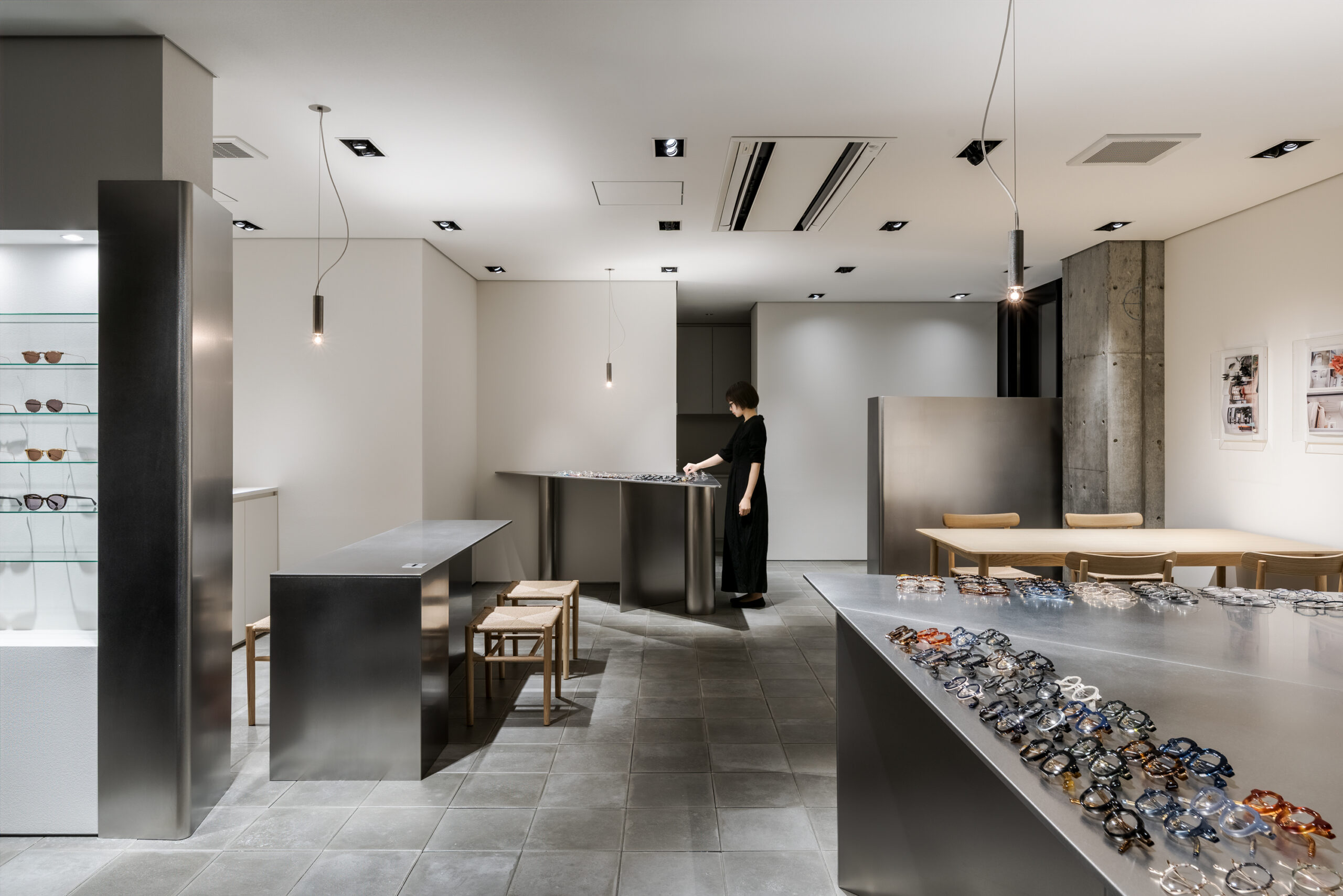
芦屋を拠点とするアイウェアストア「芦屋眼鏡舗」のインテリアデザイン。
オーナーは建築やデザインに深く興味を持ち、単に商品を販売するような従来のプランニングではなく、接客する風景や展示するアイウェアを空間の一部として捉えられるような”場”を求めていた。
ロケーションは、芦屋の閑静な街の一角。
新築で進められていたビルは、周りの道路や路線に沿って計画されたことから、多様な角度で構成された外観となり、そのアウトラインがそのまま各テナントに影響しているような区画であった。
我々はまず、従来のように建築とインテリアのデザインを隔てることなく、歩幅を合わせた空間作りができないかと考察した。
そこで、多様な角度を用いられた外壁(構造)に沿うように、オフセット(ずらし)しながら複製し、内部壁やディスプレイ家具などインテリアラインを形成していった。
建築構造と同様の角度を帯びさせることで、建築の匂いが徐々にインテリアシンボルとして機能形成されていくようなことを試みている。
また、角度を帯びたインテリア群により、接客などのコミュニケーションにおいても角度を帯びる結果へと繋がっていく。
さらには、スケルトンを生かした開放感のある天井を選択せず、あえて落ち着きのある天井の低いシーンを入手するために、梁型が隠れる天井ラインまで高さをコントロールした。
しかし、露骨なスケルトン天井の迫力ある魅力を塞ぐことは、時に空間として弱点となりうるため、300角のスクウェア形状に形取ったコンクリート平板を床に用いることで、建築が持つ力を内装に転換維持している。
オリジナルのペンダントライトも建築、家具の延長線上に位置するものとし、什器同様のマテリアルを採用した。
コンパクトな照明ではあるが、ワイヤー吊りすることでソケットとコードの関係性を柔らかなものにしている。
アイウェアが空間に溶け込むことで、丁寧にメガネと対峙できるような”場”を目指した。
-
The interior design of an Eyewear Store located in Ashiya, Hyogo, Ashiya Optical Store.
The owner had a deep interest in architecture and design, and sought a place that was not based on conventional planning focused simply on selling products, but one in which scenes of customer service and the displayed eyewear could be regarded as part of the space itself.
That location was tucked away in a quiet corner of the town of Ashiya.
The facade of the new building was articulated through multiple angles, as it was planned along the road and the railway, and its outline directly influences the tenant space.
We considered how a space could be designed with a shared rhythm, without conventionally separating architecture and interior.
Following the structure of the exterior walls, articulated through multiple angles, the geometry was duplicated with subtle offsets. Through this process, a series of interior lines were generated, forming internal walls and display furniture.
By introducing angles similar to those of the architectural structure, we attempt to allow the presence of architecture to gradually emerge and function as an interior symbol.
Customer interactions are also articulated through a series of angular interior elements.
Furthermore, rather than exposing the skeletal ceiling to emphasize openness, the ceiling height was deliberately controlled to conceal the beams, creating a calmer spatial atmosphere.
However, enclosing the raw presence of the skeletal ceiling risks weakening the space by diminishing its dynamic character.
To reinterpret and retain the architectural force, 300 × 300 mm square concrete paving slabs were introduced to the floor.
The original pendant lights were positioned along the same line as the architecture and furniture, adopting the same materials used for the display fixtures.
Although the light itself is compact, suspending it by wire softens the relationship between the socket and the cord.
By allowing the eyewear to blend seamlessly into the space, the store aims to create a place where each pair of glasses can be approached with care and attention. -
DA OSAKA Branch Tokyo株式会社 デイエイ・オーサカ 東京オフィス
- Type of Project : Interior/内装設計
- Category : Office/オフィス
- Location : Japan/日本
- Area : 165㎡/165平米
大阪に本社をおき、店舗・商業施設の内装工事を行うデイエイ・オーサカの東京支店のオフィス計画。
ロケーションは東京都千代田区神保町で、書店や古書店が集中する「本の街」として発展し、多くの出版社も集まり、現在も世界有数の出版集積地として豊かな文化を育んでいる。
今回の立地となる日本橋川に沿うように立つビルは、「新聞之新聞ビル」 の名の下、新聞印刷が行われていたという。竣工当時から変わらない丁字色のタイルに覆われた美しい外観をし、この歴史ある街並みに溶け込んでいるように感じた。
特に着目すべき視点として、計画する2階エリアには、従来のようにエレベーターから出入りできるルートの他に、中央階段として2階エリアに直接アクセスできるような、屋外からの直線階段が設けてられていた。
我々は、これからの人の”流れ”の中心となるこの場所を空間の起点となるように、入口を2階から1階に押出すことで、外部扱いだった階段を内部のものとして包括しつつ、内部としてのアプローチを引き延ばすことで、メインエントランスとしての領域強化の計画を進めていった。
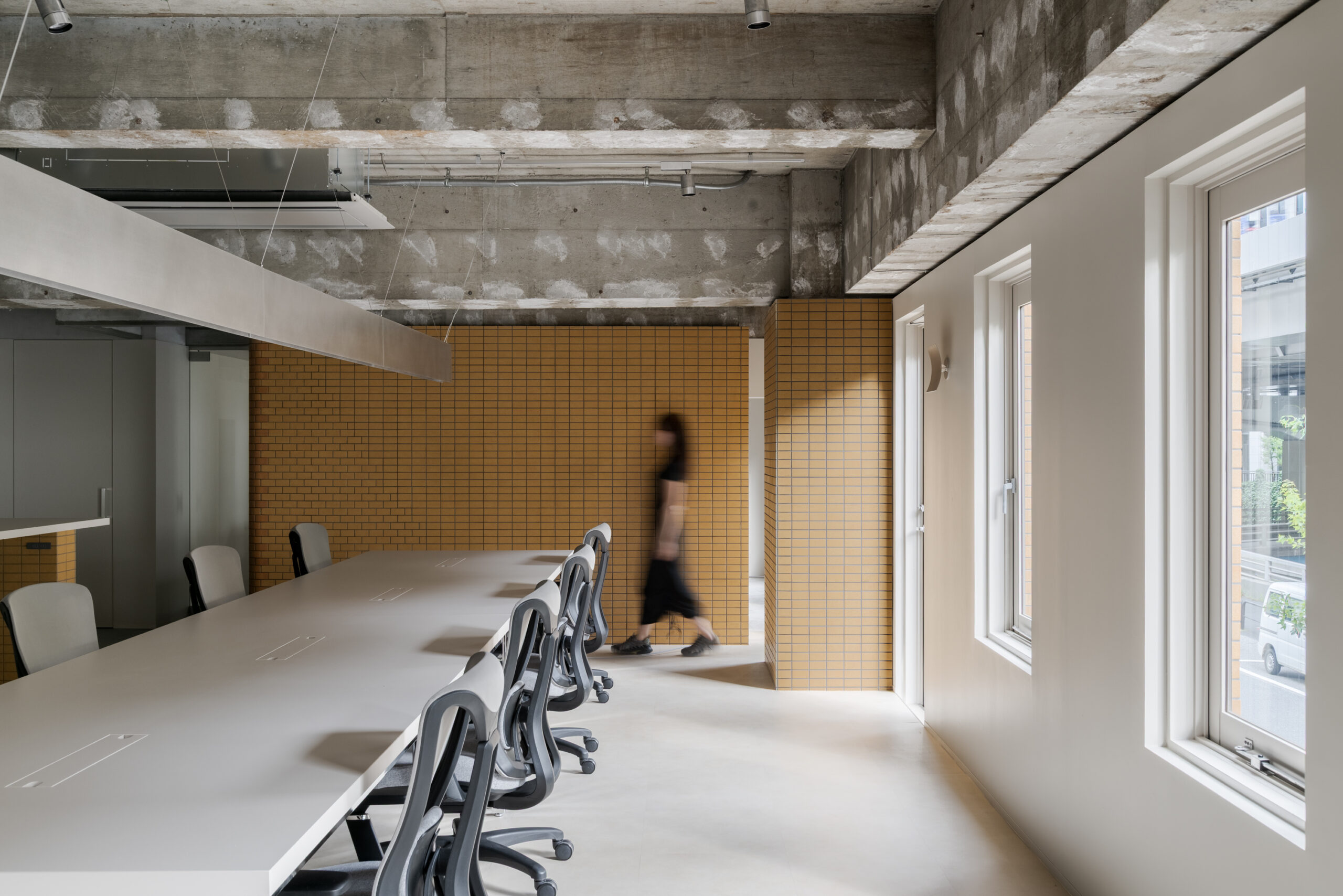
まず、外部の丁字色タイルを2階内部に引き延ばす事と共に、階段を囲む両の壁には蒲鉾状の小口を形成して、領域の接点をなめらかに繫げる行為を表現している。
一部壁面の長方形の開口は、以前利用されていたと思われる新聞受けをそのまま残したものである。
更には、タイル要素をエントランス周りだけでなく、執務スペースの柱や家具の一部に伝染させることで、空間全体として内外を深い関係性に仕立てている。
また、古書のめくる所作をヒントに、円弧状のディテールを帯びたステンレス製のペンダントやブラケットの造作照明器具を用意した。
人、時間、エネルギーが交差するこの場所で、新たな歴史が加わることを願っている。
-
DA-OSAKA, headquartered in Osaka, is a company specializing in interior construction for commercial premises. This project is for their Tokyo branch office.
Located in Jinbou-cho Chiyoda, Tokyo where well known as “Town of Books” because of densely packed bookstores and vintage bookshops, and maDA-OSAKA, headquartered in Osaka, is a company specializing in interior construction for commercial premises. This project is for their Tokyo branch office.
People say, it was newspaper printing used to take place here, under the name of “Shinbun-no-Shinbun Building”.—in English, “the Newspaper building of newspaper”. It is along the Nihon-bashi River, unchanged facade covered with clove-dyed brown tiles since its completion, which feels like it melts into this historical urban fabric.
A noteworthy point is that there are two routes to the second floor: a straight central staircase providing direct access from outside, in addition to the usual elevator.
We aim to make this place the heart of future human flow and the origin of the entire space by enhancing the project to. Enhance the space as a main entrance by shifting the entry point from the second floor to the first, extending the inner approach to draw the formerly external staircase into the internal realm of the office.
For the first step, express a smooth transition between connected realms by forming a semicircular end profile on the wall surrounding the staircase, and by extending clove-dyed brown tiles into the interior of the second floor.
A deliberately left rectangular opening in part of the wall seems to have been used as a mail slot.
Furthermore, tile elements infuse not only the entrance area but also the pillars in the workspace and parts of the furniture, leading to a carefully tailored interior and exterior to cultivate a deep relationship throughout the entire space.
Also, devised custom-made lighting fixtures imbued with the elegant movement of turning vintage books, including a bracket light and a stainless steel pendant laden with arc-shaped details.
We wish for a new history to unfold here, one that interweaves people, time, and energy.
-
HOUSE IN YOKOSUKA 1st横須賀の住居 一期工事
- Type of Project : Newly build/新築
- Category : Residence/住居
- Location : Japan/日本
- Area : 800.44㎡/800.44平米
都心に住む家族のための週末住宅の建築デザイン。
海沿いに位置するロケーションであり、森林たちは吹きつける海風を浴びている。
敷地近くには浜が隣接し、週末になればアクティブやサンセットを楽しむ地元民で賑わう。
大地がつくる海、白い砂浜の延長上に建物が存在し、
浜辺をプライベートビーチとして演出するような計画を考えた。
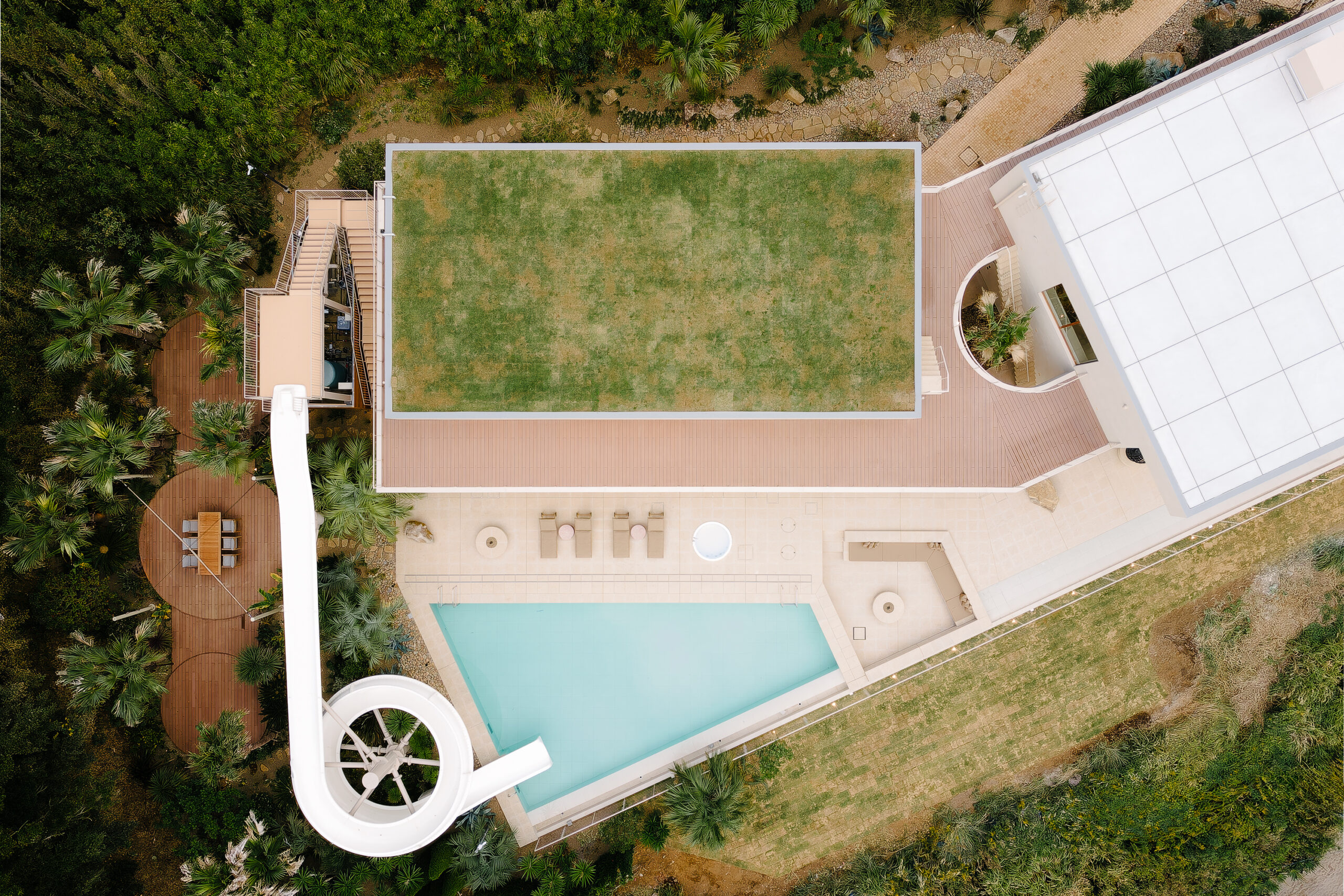
別荘であることから、ヴィラのような存在を意識し、母屋、多目的棟、ガレージ棟といった用途に合わせた建物を用意し、その間に庇を兼ね備えたプレートを浮かせることで、分離されたオブジェクトを繋いでいる。
この建築の多くを占めるのは、砂浜をモチーフとして選定した花崗岩(グラニット)で、躯体の柱ピッチに従い、石スラブから500x500mmのサイズに切出したものを使用している。
壁や天井においても、同じ視点から砂の骨材を含んだオリジナル左官で施し、質感でグラデーションを発生させている。
屋外で使用しているマテリアルを屋内でも使用することにより、内外の関係性が分離されることを回避したデザインとしている。
外構には施主の希望で、 オリーブやピロウヤシなど南国系の植物を植え、周囲の既存樹木と対比させながらも色彩の調和を図り、うまく環境に溶け込ませている。
敷地内に点在させた景石は、砂と同様のベージュ系統の配色にするため、岐阜県の木曽石を選定した。
メインとなるダイニングエリアでは、コの字カウンターと大判の特注鉄板を配置し、海を眺めながら最大10人のゲストをもてなす役割としている。
また、関西を拠点に活動するSAI氏を招き、空間コンセプトに合わせたオリジナルテクスチャーで、壁面の大部分やキッチンフードオブジェクトして捉えたものに変換している。
ダイニングのペンダントライトや寝室のブラケットライトはオリジナルで製作。
海水に浸された砂浜をイメージし、同じ素材でありながらも、フィニッシュを差別化しコントラストを加えた。
-
Architectural design of a weekend home for a family living in the city center
The plot is situated along the coast in the south of Yokosuka City in Kanagawa Prefecture, allowing the gentle ocean breeze to blow through the trees.
A beach is also very close to the site, and on weekends it bustles with locals who enjoy the sunset or activities at the sea.
The building is designed as an extension of the ocean and white sand of the beach created by Mother Nature,
and is positioned to make the oceanfront seem like a private beach.
As a weekend home, the building concept is based on the feel of a villa, with a main building, multipurpose annex and garage provided for different purposes. The separated buildings are connected by a floating plate with attached eaves.
A large part of the building is made of granite, selected for its visual similarity to a sandy beach and cut from a stone slab to the size of 500x500 mm blocks to fit the frame's pillar pitch.
The walls and ceilings are finished with original plasterwork containing sand aggregates to also fit to the beach motif, and a gradient texture is applied.
By using the same materials for outdoors and indoors, the design avoids a separation of these two spaces.
At the client's request, tropical plants like olives and fountain palms were planted, which contrast with the existing trees in the neighborhood while giving a harmonious color palette and make the exterior blend in with its surroundings.
Kiso stone from Gifu Prefecture was chosen for the decorative stones scattered throughout the grounds to match the beige color scheme of the sand.
The main dining area features a U-shaped counter and a large custom-made griddle to provide enough space to entertain up to ten guests while enjoying the view of the ocean.
Kansai-based SAI was asked to transform a large part of the wall surfaces and the kitchen hood with original textures into objects that match the spatial concept.
The pendant lights in the dining rooms and bracket lights in the bedroom are custom-made originals.
The same materials were used to create a resemblance to a sandy beach covered by seawater, but different finishes were employed to add contrast.
PRESS
-

APIDA 2025 Distinction Award Winner
Mon. 05 / 01 / 26
-
Dezeen Awards 2025 shortlist
Wed. 08 / 10 / 25
-

A’Design Award & Competition 2024 受賞
Tue. 01 / 10 / 24
-

Wallpaper Smart Space Awards 2024 winners
Thu. 01 / 08 / 24
-

“JDN”に「空間の欠片(かけら)」を紹介して頂きました
Tue. 11 / 06 / 24
-
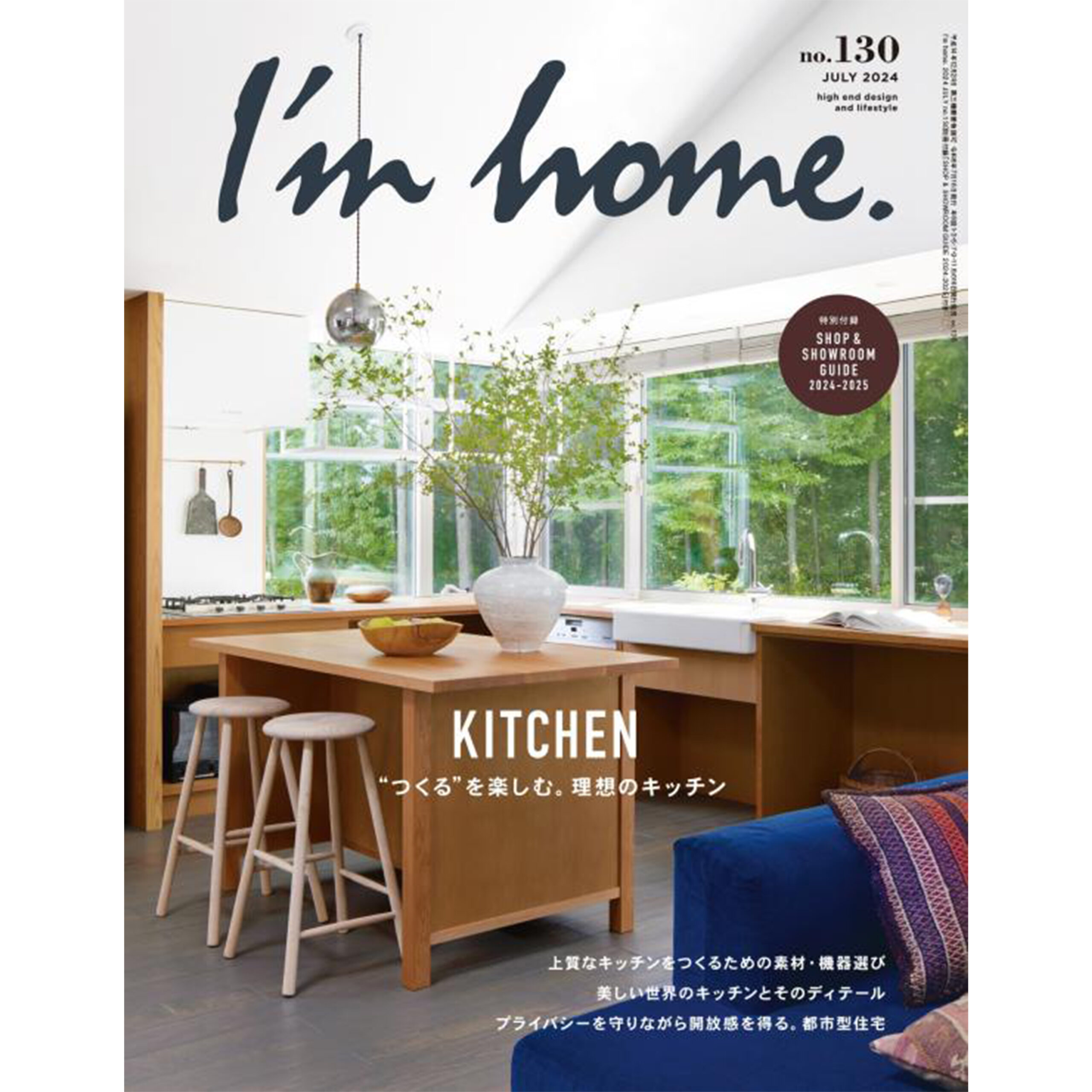
「I’m home.」no.127 2024年1月号 掲載されました
Mon. 01 / 01 / 24