-
INDICATION structureインディケーション ストラクチャー
- Category : Installation/インスタレーション
- Location : Japan/日本
- Area : -
- Constructor : -
円をかたどる。
約150万年前、イスラエル北部では初期人類のホモ・エレクトスは天然の洞窟の奥を住居とし、尖った打製石器を用いて集団で狩をして、マンモスを追ったり、小動物を罠で捕らえたりしていた。
そして、火打石によって焚かれた火を円形に囲み、収穫した肉を加熱調理し、皆で食事を楽しんでいた。
また、アフリカの原住民の住居は、拾ってきた低木をドーム状や円錐状に差しかけ、木の皮で結わえた後に葉や藁のマットで覆い、仮小屋としてもぐり込んでいた。
移動時はラクダやロバで小屋の骨組みや所持品、時には枝で編んだ扉も運んでいた。
人間の図像認識は丸からスタートしている。
年少の息子にえんぴつを持たせると、人も動物も家も全て丸く描き、棒を持たせば地面には無造作な丸い図形が並び、そこで飛び跳ね、遊びだす。
人類の無意識的な造形は丸と考えても良いのかもしれない。
ラウンドを主張するアウトラインは、人間の内面や所作、暮らし、コミュニティの始まりをトレースしている。
人の暮らしの、先々に起こる出来事や状態についての前触れ、何かが起こる前に現れる現象や感覚、自然現象、人的現象など、コミュニティが発生する ”兆し”
まだ不安定な存在ながらも、これから必ず何か起こることが約束されている。
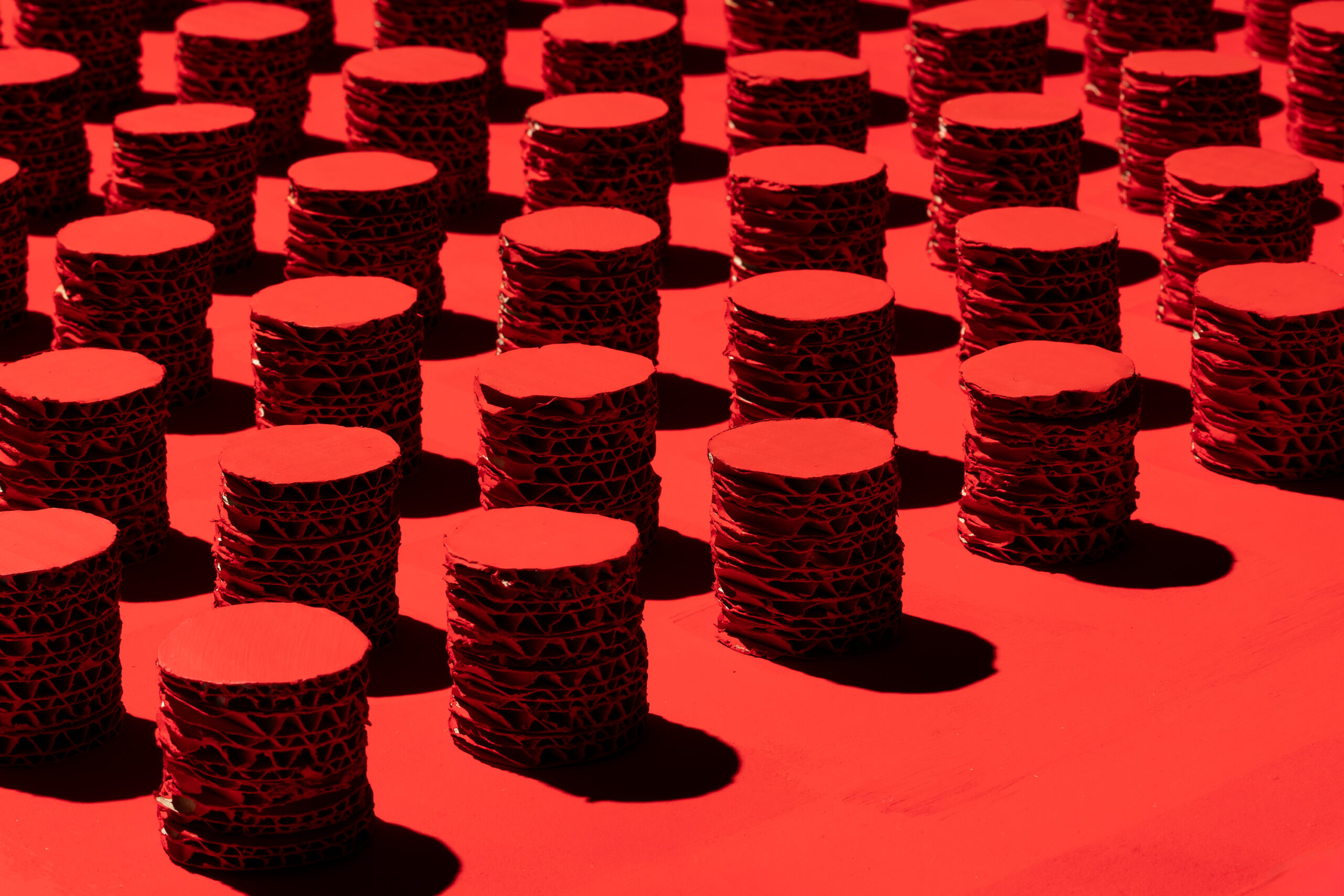
本作品は、狩猟採集から農耕へと移行し、人々が定住することでコミュニティを形成していく過程を、小さなスケールの構造体として再構築するインスタレーションである。
グリッド状に点在する正円形プレートは、集落の風景を抽象的に擬似化したアウトラインとして配置。
均質に並ぶ円盤は個々の住まいを示すと同時に、互いの距離や関係性によって成立するコミュニティの構造を示唆している。
マテリアルとして用いられたダンボールのハニカム積層は、軽やかでありながら内部に連続した構造を持ち、複数の要素が支え合うことで成立する強度を備えている。
この特性は、人々が関係を築き、相互に支え合いながらコミュニティを形成していく過程と重ね合わされている。
さらに全体を赤くペイントする行為は、健康・豊作・幸福を祈る象徴的な行為であり、太陽崇拝という人類の根源的な信仰を想起させるものである。
使用されている段ボールの一部には再利用素材が含まれており、それは狩猟における戦利品としての毛皮などの獲得に重ねられると同時に、現代におけるサスティナブルな循環の思想を内包している。こうして本作品は、過去と現在の価値観を横断しながら、コミュニティの生成とその持続のあり方を問いかける。
-
Moulding the Arc.
About 1.5 million years ago, the primitive humans—Homo erectus inhabit a depth of natural cave, catching small animals by traps, and hunting mammoth in groups using sharp chopped stone tool.
Then, they enjoyed their dish circled the started fire burned by flints, and cooking caught meats.
Also, the indigenous peoples in Africa slipped into huts with covered a mat made from leaves and straw tied together with bark, after arranged collected shrubs into dome-shaped or cone-shaped structures.
When they migration, they carried skeletal frame of huts and, sometimes wicker doors on camels and donkey.
The Icon recognizability starts from CIRCLE.
My first year of kindergarten son draws all animals and people roundly, in the grasp of pure his hand, the stick brings forth circles without destination on the ground, and upon them he frolics and leaps.
The circle may be the shape that humanity moulds unconsciously.
The outline emphasis a round is tracing the start of people’s community, personality, conduct, and life
In human life, the omens of what is yet to come — phenomena or sense that lies before events unfold, in nature or among people — The very “Indication” that herald the rise of community.
It is unstable being, yet something is destined is sure to happen.
This installation reconstructs, on a small scale, the process by which humans transitioned from hunting and gathering to agriculture, settling in one place and forming communities.
The circular plates arranged in a grid evoke the outlines of a settlement in abstract form. While each uniformly placed disc represents an individual dwelling, the distances and relationships between them also suggest the underlying structure of a community.
The honeycomb-layered cardboard used as the primary material is lightweight yet internally continuous, deriving its strength from the way its many elements support one another. This structural quality parallels the way communities are built through relationships of mutual support and interdependence.
The act of painting the entire installation red further functions as a symbolic gesture expressing prayers for health, abundant harvests, and happiness, while also recalling humanity’s ancient reverence for the sun.
Some of the cardboard used in the work incorporates recycled material. This alludes both to the acquisition of animal hides and other materials obtained through hunting and to the contemporary ideal of sustainable resource circulation. In doing so, the installation traverses past and present values, inviting reflection on how communities are formed and how they endure. -

INDICATION36インディケーション36
- Category : Installation/インスタレーション
- Location : Japan/日本
- Area : -
- Constructor : -
円をかたどる。
約150万年前、イスラエル北部では初期人類のホモ・エレクトスは天然の洞窟の奥を住居とし、尖った打製石器を用いて集団で狩をして、マンモスを追ったり、小動物を罠で捕らえたりしていた。
そして、火打石によって焚かれた火を円形に囲み、収穫した肉を加熱調理し、皆で食事を楽しんでいた。
また、アフリカの原住民の住居は、拾ってきた低木をドーム状や円錐状に差しかけ、木の皮で結わえた後に葉や藁のマットで覆い、仮小屋としてもぐり込んでいた。
移動時はラクダやロバで小屋の骨組みや所持品、時には枝で編んだ扉も運んでいた。
人間の図像認識は丸からスタートしている。
年少の息子にえんぴつを持たせると、人も動物も家も全て丸く描き、棒を持たせば地面には無造作な丸い図形が並び、
そこで飛び跳ね、遊びだす。
人類の無意識的な造形は丸と考えても良いのかもしれない。
ラウンドを主張するアウトラインは、人間の内面や所作、暮らし、コミュニティの始まりをトレースしている。
人の暮らしの、先々に起こる出来事や状態についての前触れ、何かが起こる前に現れる現象や感覚、自然現象、人的現象など、コミュニティが発生する ”兆し”
まだ不安定な存在ながらも、これから必ず何か起こることが約束されている。
本作品は、人類が狩猟採集の移動生活から農耕による定住へと移行し、コミュニティが形成されていく過程を「物」として可視化するインスタレーションである。
グリッド状に点在する直径1200mmの円形プレートは、集落の風景を抽象的に擬似化したアウトラインとして配置。
均質に並ぶ円盤は個々の住まいを示すと同時に、互いの距離や関係性によって成立するコミュニティの構造を示唆している。
マテリアルとして用いたラワンの積層合板は、複数の層が重なり合って一つの強度を生む素材であり、
人々が協働によって社会を築くコミュニティの「構造」として捉えている。
また、それぞれの円形プレートは石によってわずかに傾けられ、その方向は太陽の位置を示唆し、人間の生活が自然や時間の循環と結びついていることを表す。
鑑賞者がその間を歩くことで、点在する要素は空間的な関係を持ち、集落が立ち現れる。
-
Moulding the Arc.
About 1.5 million years ago, the primitive humans—Homo erectus inhabit a depth of natural cave, catching small animals by traps, and hunting mammoth in groups using sharp chopped stone tool.
Then, they enjoyed their dish circled the started fire burned by flints, and cooking caught meats.
Also, the indigenous peoples in Africa slipped into huts with covered a mat made from leaves and straw tied together with bark, after arranged collected shrubs into dome-shaped or cone-shaped structures.
When they migration, they carried skeletal frame of huts and, sometimes wicker doors on camels and donkey.
The Icon recognizability starts from CIRCLE.
My first year of kindergarten son draws all animals and people roundly, in the grasp of pure his hand, the stick brings forth circles without destination on the ground, and upon them he frolics and leaps.
The circle may be the shape that humanity moulds unconsciously.
The outline emphasis a round is tracing the start of people’s community, personality, conduct, and life
In human life, the omens of what is yet to come — phenomena or sense that lies before events unfold, in nature or among people — The very “Indication” that herald the rise of community.
It is unstable being, yet something is destined is sure to happen.
This work is an installation that gives tangible form to the process by which humanity shifted from a nomadic hunter-gatherer way of life to settled agricultural living and communities began to form.
Discs 1,200 mm in diameter are scattered in a grid-like arrangement, positioned as outlines that abstractly evoke the landscape of a settlement.
The uniformly arranged discs represent individual dwellings while also suggesting the structure of a community, formed through the distances and relationships between them.
The lauan laminated plywood used as the material is a substance in which multiple layers overlap to produce a single strength, and is understood here as the “structure” of a community in which people build society through collaboration.
In addition, each disc is tilted slightly by a stone, and its orientation suggests the position of the sun, expressing how human life is tied to nature and the cycle of time.
As viewers walk among them, the scattered elements take on spatial relationships, and a settlement emerges.
-
INDICATIONインディケーション
- Category : Installation/インスタレーション
- Location : Japan/日本
- Area : -
- Constructor : -
円をかたどる。
約150万年前、イスラエル北部では初期人類のホモ・エレクトスは天然の洞窟の奥を住居とし、尖った打製石器を用いて集団で狩をして、マンモスを追ったり、小動物を罠で捕らえたりしていた。
そして、火打石によって焚かれた火を円形に囲み、収穫した肉を加熱調理し、皆で食事を楽しんでいた。
また、アフリカの原住民の住居は、拾ってきた低木をドーム状や円錐状に差しかけ、木の皮で結わえた後に葉や藁のマットで覆い、仮小屋としてもぐり込んでいた。
移動時はラクダやロバで小屋の骨組みや所持品、時には枝で編んだ扉も運んでいた。
人間の図像認識は丸からスタートしている。
年少の息子にえんぴつを持たせると、人も動物も家も全て丸く描き、棒を持たせば地面には無造作な丸い図形が並び、
そこで飛び跳ね、遊びだす。
人類の無意識的な造形は丸と考えても良いのかもしれない。
ラウンドを主張するアウトラインは、人間の内面や所作、暮らし、コミュニティの始まりをトレースしている。
人の暮らしの、先々に起こる出来事や状態についての前触れ、何かが起こる前に現れる現象や感覚、自然現象、人的現象など、コミュニティが発生する ”兆し”
まだ不安定な存在ながらも、これから必ず何か起こることが約束されている。
-
Moulding the Arc.
About 1.5 million years ago, the primitive humans—Homo erectus inhabit a depth of natural cave, catching small animals by traps, and hunting mammoth in groups using sharp chopped stone tool.
Then, they enjoyed their dish circled the started fire burned by flints, and cooking caught meats.
Also, the indigenous peoples in Africa slipped into huts with covered a mat made from leaves and straw tied together with bark, after arranged collected shrubs into dome-shaped or cone-shaped structures.
When they migration, they carried skeletal frame of huts and, sometimes wicker doors on camels and donkey.
The Icon recognizability starts from CIRCLE.
My first year of kindergarten son draws all animals and people roundly, in the grasp of pure his hand, the stick brings forth circles without destination on the ground, and upon them he frolics and leaps.
The circle may be the shape that humanity moulds unconsciously.
The outline emphasizes a round tracing the start of people’s community, personality, conduct, and life.
In human life, the omens of what is yet to come — phenomena or sense that lies before events unfold, in nature or among people — The very “Indication” that herald the rise of community.
It is unstable being, yet something is destined is sure to happen.
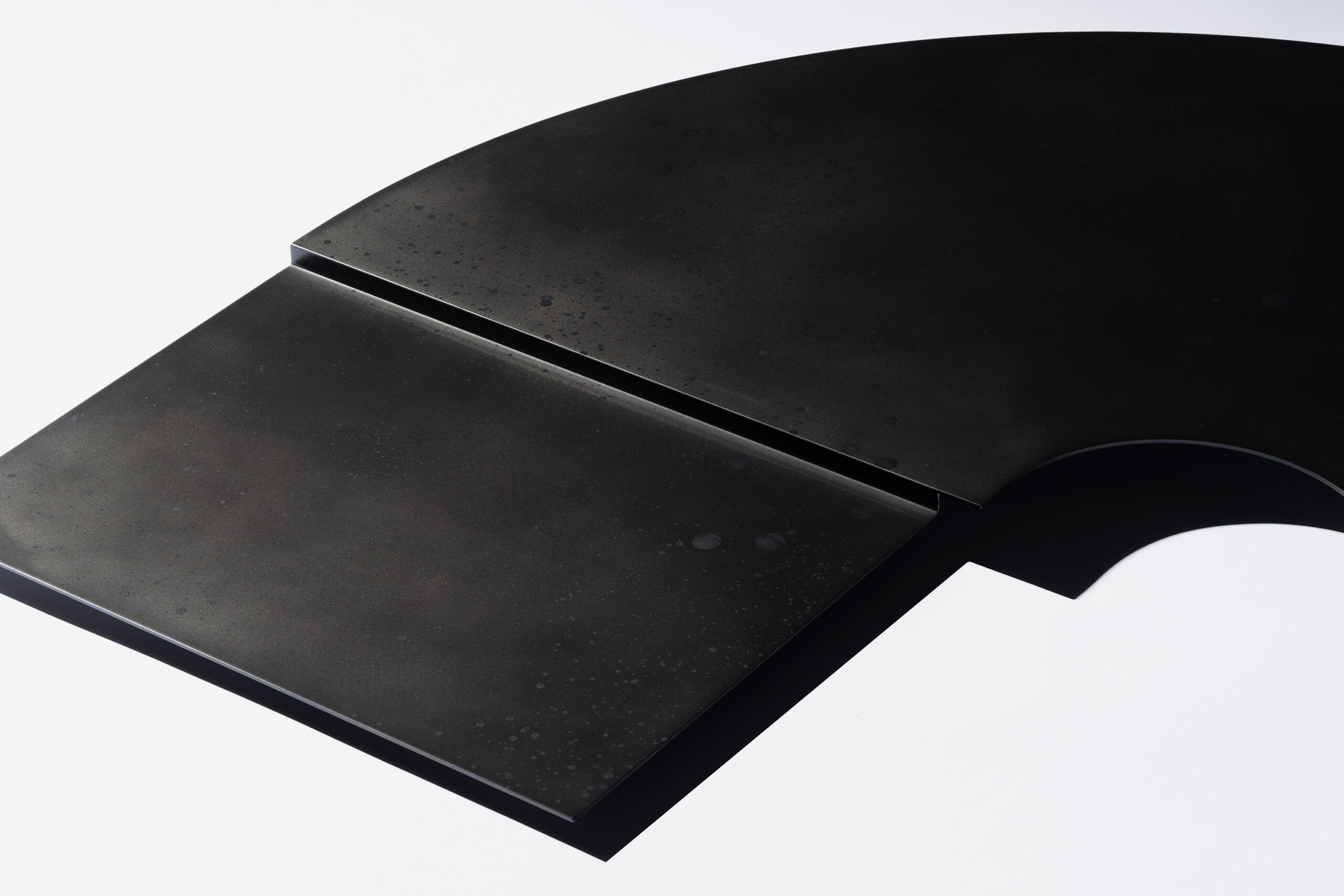
This installation gives tangible form to the process by which humans have transitioned from a nomadic hunter-gatherer existence to settled agricultural life, tracing the emergence of community.
The changes in level and interrupted arcs created by the steel plates suggest the twists, setbacks, and discontinuities in the process through which humanity acquired knowledge and advanced, inscribing into space a path of human development that was anything but linear.
The spotted pattern created through spattering paint across the surface evokes rituals performed to pray for rain, giving visual form to the very phenomenon of rainfall.
Together, these elements express how reverence for nature and human endeavor intertwine to give rise to community.